W
Location
Mexico City, Mexico
Scope
Interior Design,
FF&E and Styling
Project Manager
Daniela García
FF&E
Andrea Castro
Emilio Muniello
CD Supervisor
Jhan Chavarría
General Contractor
Grupo Cuarit
Grupo Cuarit
Construction Manager
Guadalupe Vargas
Guadalupe Vargas
On site Coordinator
Viridiana Jaime
Photography
Zaickz Moz
In Mexico City, where density and verticality define much of how the city is inhabited, W Apartment proposes a different register of domestic life — one measured not in square meters but in the quality of stillness it makes possible. The project is, in every sense, characteristic of how Santiago Cuaik works: across every scale his studio undertakes — a restaurant, a residence, a hospitality masterplan — the approach remains constant.
Architecture, art, furniture, and design are not layered onto a space but curated into it simultaneously, each element chosen in direct relationship to the others.


The living room and the staircase that rises from it are, together, the project's central statement. The double-height volume of the living room is counterweighted by the low, enveloping arrangement of Saint Germain sofas and Le Club armchairs by Poliform — a spatial tension between verticality and groundedness that defines how the room is experienced rather than simply seen.
The complexity grows with scale; the standard of attention does not. Across 1,030 square meters distributed over two levels and a rooftop, W Apartment is where that philosophy finds one of its most complete expressions.

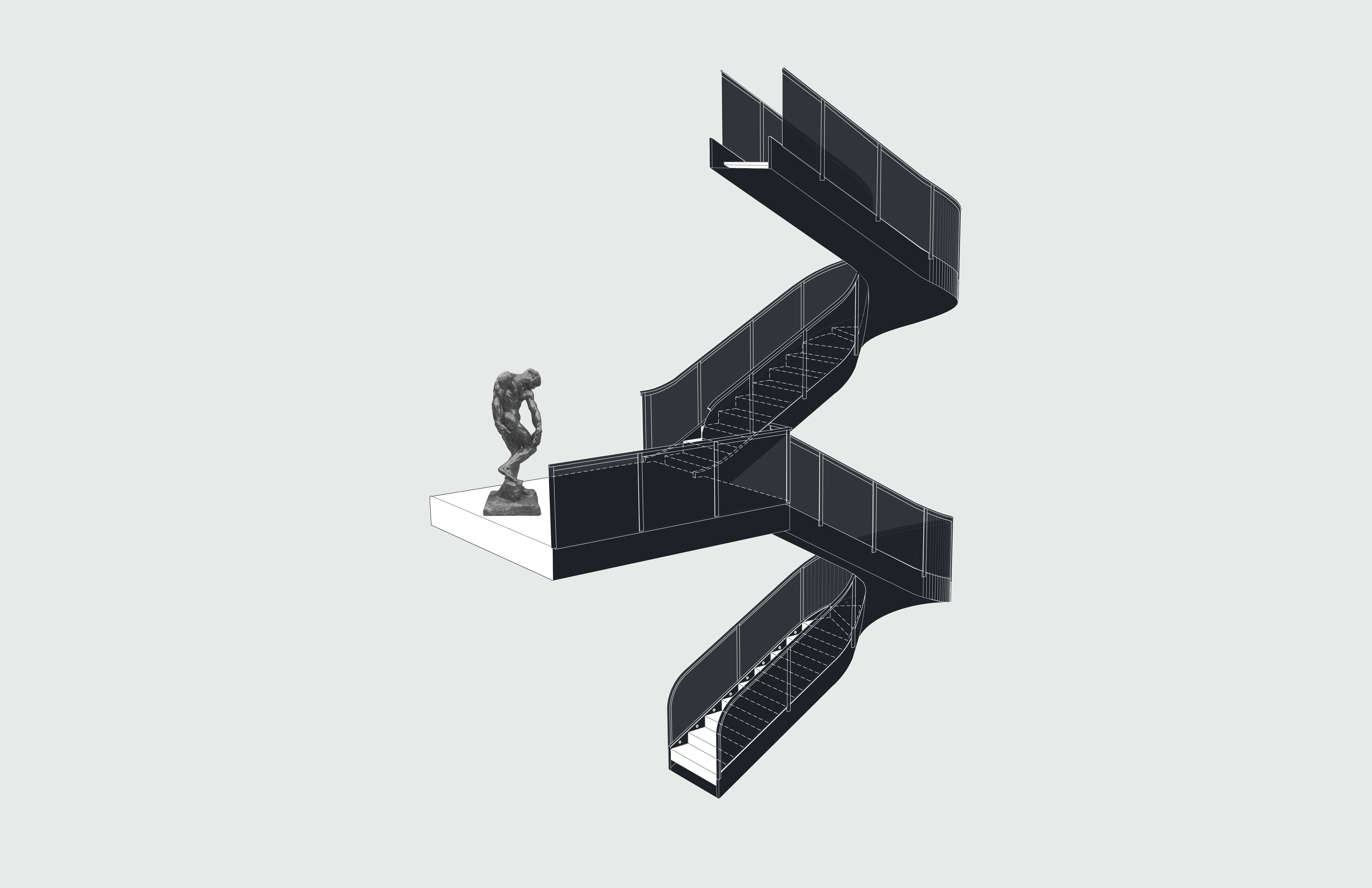


The staircase makes that argument physically. Clad in continuous brass sheets, it reflects and modulates light throughout the day, shifting presence as the hours change — less a circulatory element than a sculptural one that happens to connect two levels. In dialogue with the wood slat walls, it consolidates a vertical journey that is simultaneously structure and object, infrastructure elevated into sculpture. It is the space where the project's central idea becomes most legible.
The dining room is conceived for living at scale: a dark ash table for twelve, Yoko chairs by Minotti, filtered light through curtains that softens the formality without dissolving it. A bar and listening room adjoin the space through sliding doors that replicate the wall finishes — a material sleight of hand that reinforces continuity while carving out a more intimate counterpart.


The guest bathroom is conceived as a contained and sophisticated space, where burgundy lacquer envelops the room and defines a deep, elegant atmosphere.
The kitchen resolves a different tension entirely: a monochromatic composition of light woods and a stainless steel island where order and calm become the defining aesthetic, legibility as a form of beauty.


Upon reaching the upper level — via the sculptural staircase or the elevator — the circulation opens onto a contained vestibule that signals the transition into the apartment's private areas. The shift is atmospheric rather than abrupt: the same materials, the same quality of light, but the scale pulled inward.


